July 1, 2026
Last week, ALGAESOL travelled to the sun-soaked island of Kos, Greece, for one of Europe’s leading gatherings on waste management and the circular economy. Representing the project was Ylva Katarina Wedmark, Researcher at the Norwegian Research Centre (NORCE), who brought ALGAESOL’s work on sustainable microalgae-based fuels to both the poster hall and the podium.
A Front-Row Seat to the Field
“The conference was a valuable learning experience, providing insights into renewable fuels, sustainability assessment, regulatory developments, and current challenges in LCA methodology,” Ylva reflects.
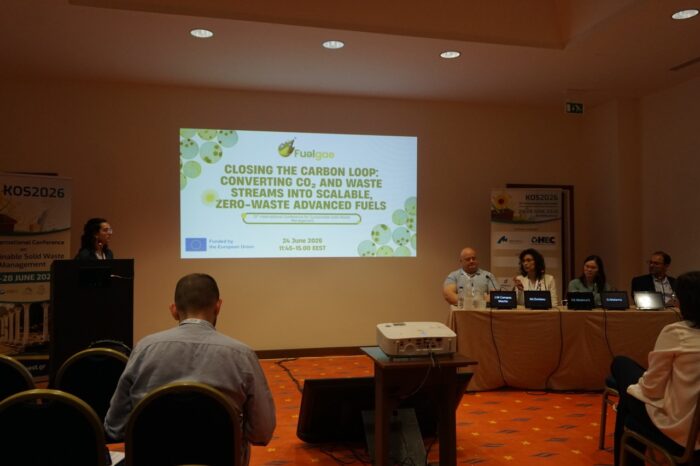
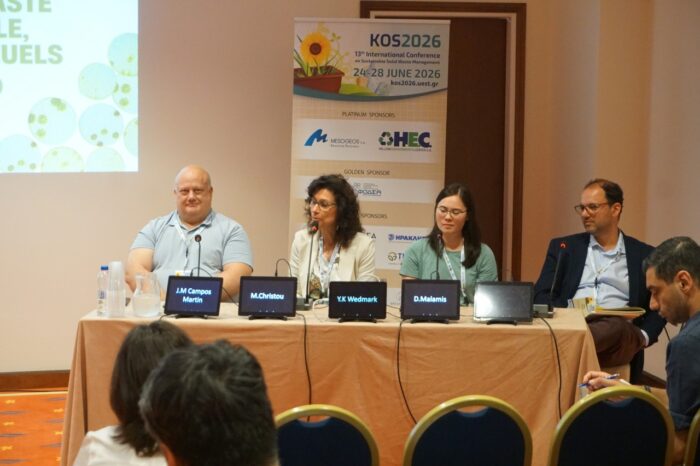
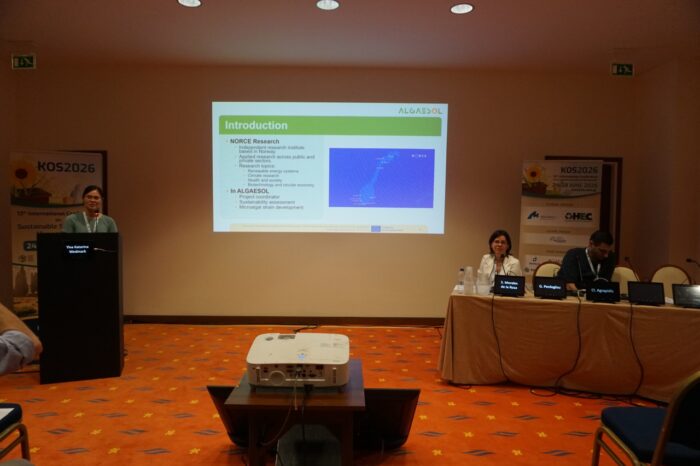
On 24 June, Ylva took part in the FUELGAE-led workshop “Closing the Carbon Loop: Converting CO₂ and Waste Streams into Scalable, Zero-Waste Advanced Fuels,” delivering an overview presentation of ALGAESOL to a room full of fellow European researchers. She then joined the panel discussion on renewable fuel regulations, where the conversation turned to one of the field’s biggest open questions: how do we prove a fuel is truly sustainable?
“The discussions highlighted the potential of LCA as a tool for documenting fuel sustainability, while also emphasizing the need for improved data quality, verification, and communication of uncertainty,” she notes.
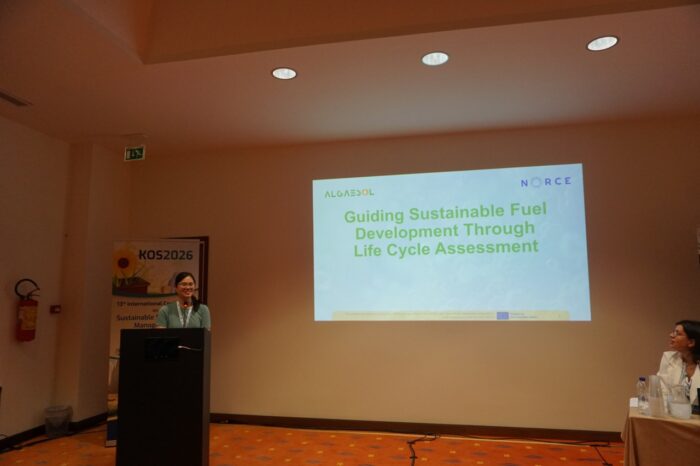
Alongside her appearance at the stage, Ylva presented a poster on ALGAESOL’s Life Cycle Assessment (LCA) and Life Cycle Costing (LCC) work, the analyses behind the environmental and economic footprint of our microalgae-based fuels.
A Big Stage for a Big Mission
The 13th International Conference on Sustainable Solid Waste Management (KOS 2026) is no small affair, drawing researchers, industry experts, policymakers, and local authorities from across the globe, with organisers reporting more than 750 submitted abstracts for this edition alone. It’s exactly the kind of forum where projects like ALGAESOL can find the audience — and the collaborators — that matter most.
Thank You, FUELGAE!
A warm thank-you to our sister project FUELGAE for organising such a thoughtfully curated workshop, bringing FUELGAE, CRONUS, ICARUS, and ALGAESOL together to trade notes on microalgae CO₂ capture, closed photobioreactors, digital twins, and Raman spectroscopy monitoring. Moments like these are exactly how the EU’s advanced fuels community accelerates progress together.
Beyond the Stage
Some of the trip’s best moments happened off-stage. Ylva connected with ITENE, a FUELGAE partner also working on LCA, to compare notes on methodology.
“It allowed us to compare methodologies and discuss harmonization of approaches, which will support future comparison of results across projects,” she says.
Looking Ahead
KOS 2026 offered a valuable snapshot of where renewable fuels and sustainability assessment stand today: full of promise, but still navigating real methodological and regulatory challenges. For ALGAESOL, the trip reinforced why we do this work — and why doing it in dialogue with projects like FUELGAE, CRONUS, and ICARUS makes all the difference.
Stay tuned for updates on our finalised LCA/LCC results, coming soon.